Hello from the Florida Charter Institute, and for those of you we haven’t yet met, welcome to our blog, FCInsights! Here at the Florida Charter Institute, our mission is to serve as Florida’s premier hub for charter excellence and insight by providing research-based best practices, resources, and support. This blog will be one avenue for centering the conversation around leading great schools, supplementing our current workshop and working group offerings, as well as our supports for authorizing and school operations.
One of the most exciting research projects we’re embarking on at FCI is a study into the world of higher education teaching programs to uncover what moves the needle in setting future teachers up for success when they come to lead classrooms and students of their own. At Miami Dade College, the new “Teach UP” program brings nationally recognized teacher training to aspiring teachers, and we’ve been excited to study this work up close.
First, to step back. At its essence, the key to adult learning is no different than student learning: sharing high-impact material and getting the ratio right. Today, I want to dive into the latter.
So, back to Paul and Jesse, our master facilitators at MDC’s School of Education. Over the arc of their session, they essentially transferred more and more of the ratio to their students through this learning cycle – which we refer to at FCI as “learn from the exemplar.” Here’s how they executed:
See It,
First, Paul helps immerse participants in the vision for exemplary instruction through a video review of master teachers (e.g., concrete experience) – as seen in this clip.
What did we see Paul do here? He begins by providing context and framing for the video to help acclimate his viewers to this moment of instruction, thereby removing potential barriers to being dropped into an isolated moment of class. He then asks a targeted question (“What do you notice about where these teachers are standing, and why is that significant?”) and offers a space for participant notes. This begins to tip the ratio toward participants: they shouldn’t just watch and “think,” but actually put their thinking down on paper. (Think even to our work with students, where we know that the act of writing deepens the cognitive process!) Paul then circulates and listens in on the conversation so he can pre-call participants to share in order to center some of the most valuable comments for the larger group. Over the course of this “see it,” Paul’s moves engage participants in the content deeply and meaningfully, slowly building up their expertise and confidence in the material so that he can subsequently push the cognitive load and strengthen the learning.
Do It
With these initial learning components in place, participants are ready for the greatest ratio push of the session: practice. Let’s watch how Paul and Jesse execute this period of active experimentation in two parts.
First, they allow participants to “prepare for practice.” Jesse sets this up beautifully: he puts this micro classroom culture technique they’ll practice back into context (“How do we do [non-verbally correct student behavior] while teaching a lesson and not breaking our flow of instruction?”); without this, practice time could feel it lacks purpose and connection to the overall goal of actually teaching students content. Next, Paul builds momentum and excitement for the practice itself with the line, “So buckle up!” Though easy to miss, this is such a powerful addition, as practice can feel intimidating and awkward, yet this builds in a small moment of joy that catalyzes participant engagement. Finally, Paul reviews the directions and offers a quick model as one last example before teachers are given time for independent preparation.
The session culmination is an actual stand-and-deliver practice designed to replicate live instruction. The value of authentic practice can’t be overstated. Returning to our original definition of ratio, this is our peak moment, where intellectual thought and concrete engagement with rigorous material converge for every teacher in the room. First, Paul sets up the practice with clear directions. Then, he and Jesse circulate and provide feedback and encouragement to teachers as they deliver, ensuring their future success in front of their actual students where it matters most. What I love most about this moment, though, is the culture that permeates the room. Teachers smile as they stand to deliver, there’s lots of evidence of celebrating one another – whether through snaps, smiles, or collegial laughter – and feedback is given and taken effortlessly. These positive culture signs really do point to successful facilitation that has set participants up to feel confident and at ease even as they are being pushed to grow.
We hope you find this ratio framework and videos helpful as you reflect on and enhance your own teaching of adults whether now or in August – and we also hope you’ll join us back here next month for our second installment of FCInsights. We’ll see you then!



 At a recent Teach UP session, I had the pleasure of observing two masterful educators and facilitators, Paul Powell and Jesse Corburn, guiding a room of future educators through techniques to ensure student engagement. As participants dove into their final practice round of the day, demonstrable skills they didn’t have at the start prominently displayed, I got to thinking: What exactly made Paul and Jesse’s session so effective? What should we all steal and replicate in our work with teachers – new, veteran, and everything in between – a question that is especially resonant as we all begin to plan for a successful launch to 24-25 via summer PD with our teaching teams.
 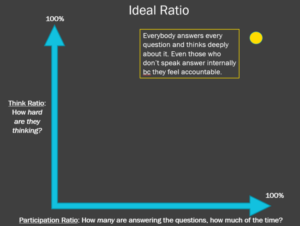 Ratio refers to how deeply students are engaged with content, often measured via the cognitive demands of the material as well as one’s level of participation with the material. At its most basic, ratio is high and learning happens when all students actively engage with deep and meaningful content [graph at the right].
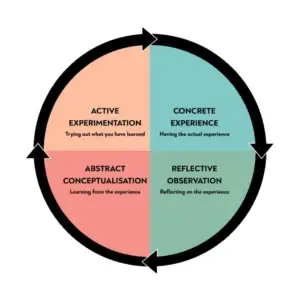 Researcher David Kolb shared important insight into ratio within the learning cycle in a 1984 published model of learning that still holds up today [image at right]: in his four-part sequence, learning starts with “concrete experience” – we all know that reading or hearing about something pales in comparison to being immersed in. Next, in “reflective observation,” you step back on that experience and attempt to make meaning of it. In “abstract conceptualization,” a learner comes to generalize or universalize their understanding, encoding it into long-term memory. And finally, the stickiest learning closes in a moment of “active experimentation” – or trying it out and practicing.