
September 2025 FCI Connect | Florida’s School Grading Scale Adjustments: What it Means and How to Navigate
Welcome to the September edition of FCI Connect
From the desk of our Executive Director
What tools are critical for leaders in the 2025-2026 school year?
A map & a compass.
Without these, leaders wander aimlessly from teacher to teacher, observing classrooms, jotting notes, and too often offering vague praise that offers NOTHING to teachers. As a leader, yes, you should praise the extraordinary efforts you see teachers make….but they will REALLY VALUE direct, substantive ways to get stronger. And with the right map & compass, you can do just that!
With these tools, you can chart a path that ensures feedback is specific, actionable, and connected to what matters most: student learning. Doug Lemov reminds us, “Practice doesn’t make perfect. Practice makes permanent.” That permanence can either be mediocrity or mastery, and the difference lies in whether teachers receive feedback sharp enough to shape their practice.
Teachers deserve feedback that isn’t a pat on the back but a mirror—clear, reflective, and useful. A good monitoring map ensures leaders don’t just notice what’s wrong, but they pinpoint the moves that drive learning forward. As Dan Willingham explains, “Memory is the residue of thought.” If leaders want students to remember, they must help teachers think deeply about the craft of instruction. That requires feedback targeted on what students are actually doing and thinking in the lesson, not simply how polished the teacher appears.
Great schools are built on habits, not accidents. A monitoring map allows leaders to revisit key practices—like checks for understanding, ratio, and clear directions—again and again until they become habits in every classroom. When used with discipline, every observation becomes an opportunity for growth rather than a compliance exercise.
The public entrusts us with their children, and that trust demands rigor not just for students but for teachers too. A monitoring map ensures no one falls through the cracks—not the struggling teacher who needs clarity, nor the strong teacher who craves the next stretch move. Schools thrive when feedback is specific, repeated, and aligned with what matters most for kids. That’s the power of having a compass & a map—it transforms observations into teacher growth and student success.
Warm Regards,
Susie
Featured Article | Florida's 2025-26 School Grading Scale Adjustments: What "A" Schools Need to Know
Jessica Chapman, FCI Support Division Lead
The Florida Department of Education (FLDOE) has announced updates to the school grading scales for the 2025-26 school year, impacting high schools, combination schools, and districts. These adjustments are a result of a state statute requiring changes when 75% or more of schools within a particular type (elementary, middle, high, combination) earn an “A” or “B” grade in the current year.
For the 2024-25 school grades, 82% of high schools and 77% of combination schools achieved an “A” or “B”. Consequently, the grading scales for these school types, as well as for districts, will be adjusted for the upcoming 2025-26 school year. Under state rule, high schools, combination schools, and districts must now earn 65% or more of possible points to be awarded an “A” grade. This represents an increase in the minimum points required for an “A” in these school types.
Here's a look at the 2025-26 grading scales:
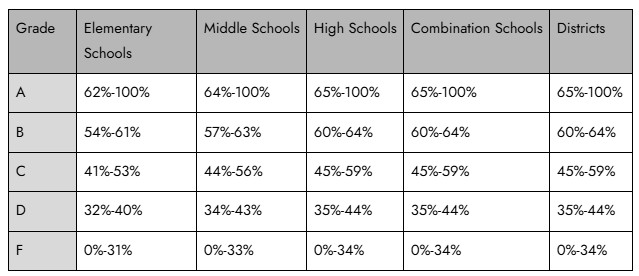
Charter schools operating as high schools or combination schools will utilize these new grading scales. It may be helpful for “A” schools to review their current points directly and analyze what they need to do to ensure they remain an “A”.
As an important aside, we also recommend that all schools ensure they are tracking the Federal Points Index, as those accountability measures are currently scheduled to begin in 2026.
What This Means for Our Community
While the adjustment may look like a small shift, its impact is significant:
-
Teachers will need to ensure strong curriculum implementation and high-impact instructional practices, as every point matters in the new accountability environment.
-
Administrators should focus on sharpening action planning, moving beyond broad categories like “ELA Achievement” to diagnosing root causes—whether they relate to content knowledge, instructional strategy, or subgroup performance.
-
Students stand to benefit from more intentional support, particularly those in the lowest 25%, as schools align resources to protect their “A” status under higher standards.
-
Parents can expect more transparency from schools about where strengths and gaps lie, and how leadership is addressing them to maintain excellence.
Looking Ahead – How FCI Can Support
As Florida raises the bar for school grading, the Florida Charter Institute is here to help schools respond with confidence. FCI equips leaders, teachers, and governing boards with targeted resources, from data analysis frameworks to professional learning and coaching support, so that schools can accurately diagnose needs and take action where it matters most. By partnering with FCI, schools can turn accountability adjustments into opportunities for sustained success for students, families, and communities.
Connect with the FCI team at info@flcharterinstitute.org or by visiting our website flcharterinstitute.org.
Questions regarding the school grading process can be directed to the Bureau of Accountability Reporting at accountability@fldoe.org or 850-245-0411.
Voices of FCI | Diagnosing Needs and Building Solutions
Kathryn Perkins, FCI Educate and Author of FCI Insights
If you’re looking to identify areas of current strength and potential areas for growth to drive your action planning, begin at a high level with the categories themselves. As many of you know, depending on the grades you support, your school is assessed in the following categories:
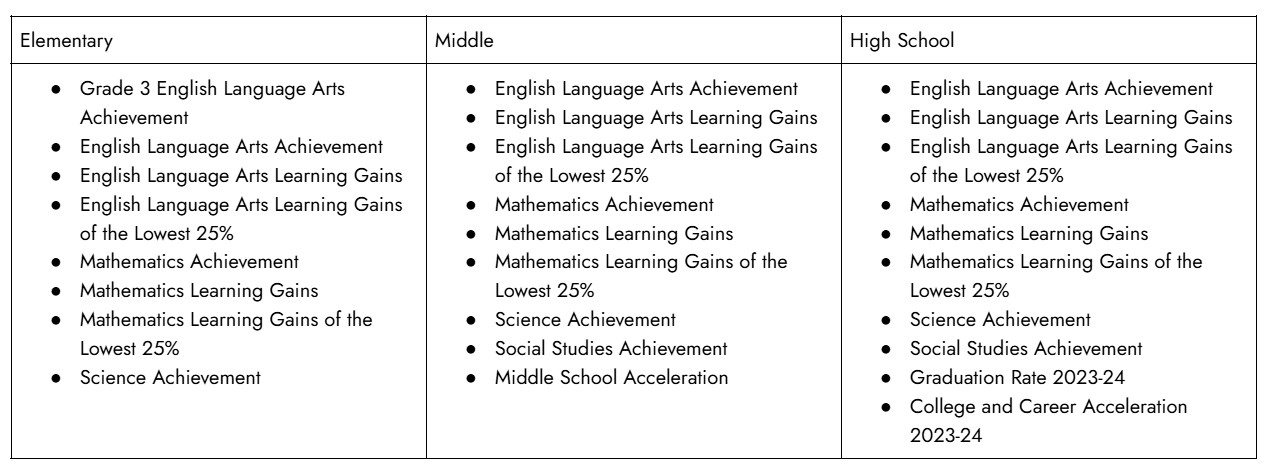
After identifying 1-2 general areas to focus your attention, you’ll want to use data from other sources – such as observations and priority school assessments – to diagnose your specific need(s); the report card categories themselves are too broad to drive a successful action plan. Some questions you can use to unpack this data:
- Within a subject area of need, are all grades struggling? Are 1 or 2?
- If all grades are struggling, is the challenge related to curriculum? Curriculum implementation?
- If certain grades are struggling, is it teacher content knowledge? Use of high-impact instructional strategies? Classroom management?
- Is supporting the lowest 25% an area of need within a particular subject area or across the board?
Make sure to spend some time here and use data to guide your analysis, remembering that correctly diagnosing your area of need is a prerequisite to any successful plan.
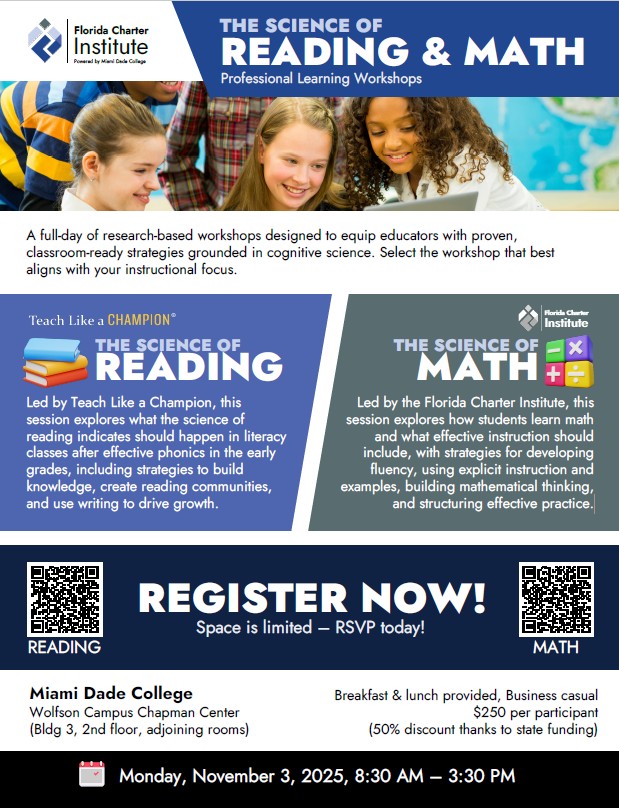
Once you’ve diagnosed your need, create a corresponding action plan. It will likely include a combination of professional learning and teacher coaching. A few resources to get you started: on November 3, we’re hosting a Science of Reading workshop with Teach Like a Champion and facilitating a simultaneous Science of Math workshop; these are great for anyone working to build teacher content knowledge, improve curriculum implementation, and/or develop high-impact teaching practices at their schools. For those digging more deeply into coaching, we recommend last month’s blog on beginning of year observations, as well as this action step guide to drive your work.
Professional Development Programs
Monday, November 3, 2025 | The Science of Reading presented by Teach Like A Champion

Led by Teach Like a Champion, this session explores what the science of reading indicates should happen in literacy classes after effective phonics in the early grades, including strategies to build knowledge, create reading communities, and use writing to drive growth.
Click here to register.
Monday, November 3, 2025 | The Science of Math presented by the Florida Charter Institute

Led by the Florida Charter Institute, this session explores how students learn math and what effective instruction should include, with strategies for developing fluency, using explicit instruction and examples, building mathematical thinking, and structuring effective practice.
Click here to register.
Upcoming Webinars
Tuesday, October 21, 2025, 1:00 p.m. | Principals Matter: Highly Effective Leadership Strategies – Common sense lessons for school leaders
Common sense leadership lessons for current and aspiring school principals. About the Author: Mr. Jorge A. Rivas has been an educator for over 38 years in both the public and charter school networks. He began his career as a high school teacher in Miami, Florida, and has served in various roles throughout his career. In addition to teaching, he has been a school counselor, district supervisor, assistant principal and a school principal for the past 17 years. He has served as a principal in elementary, middle, and high schools. He is currently the principal at a PK-12 charter school in Orlando, Florida.
Register Here
Thursday, October 23, 2025, 10:00 a.m. | E-Rate Program Overview
E-Rate is a federal program that helps schools cover costs for internet access, network equipment, and maintenance. Although a valuable resource, many schools find the E-Rate program complex and time-consuming. This webinar will provide a clear overview of E-Rate, covering eligibility, application steps (even for new schools), and insights into budgeting for Category 1 and Category 2 services. We’ll also walk through school requirements and setup in the E-Rate EPC portal. If you have questions or find the process intimidating, join us to hear expert guidance from Ben Sniecinski, President of E-Rate Advantage.
Register Here
FCI Exclusive: New! Dedicated Families Page on FCI Website
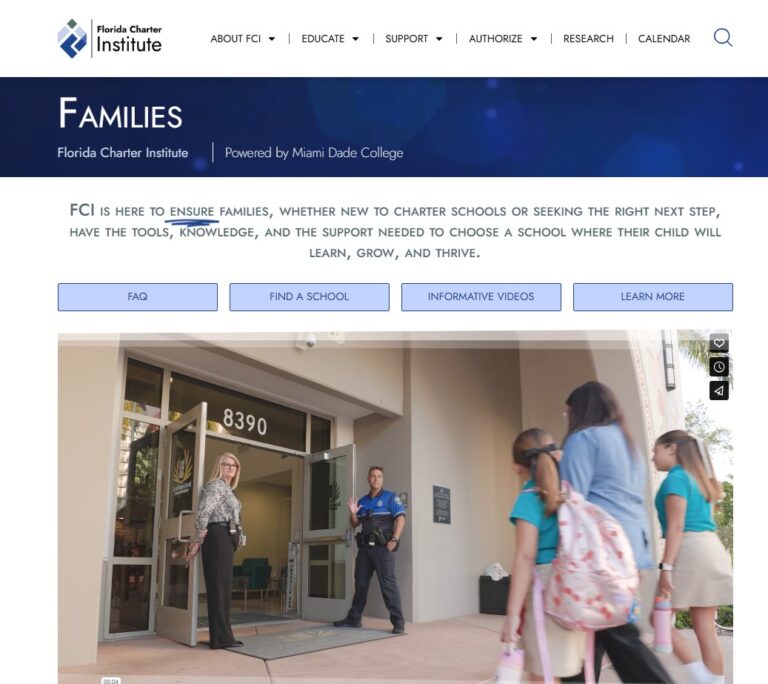
We are excited to announce our newest FCI resource, our Families page!
As the state’s premier resource hub for charter schools, FCI is dedicated to helping families understand their choices, identify the right fit, and navigate the enrollment process with confidence.
Through the Families Page, FCI offers:
- Clear explanations about what charter schools are, how they operate, and the benefits they can provide.
- Easy-to-use search tools and resources to explore schools by location, grade levels, programs, and unique offerings.
- Special education support through Exceptional Student Education (ESE) spotlights, highlighting schools that excel in serving students with disabilities and other unique learning needs.
- Practical tips and key questions to ask when evaluating school options.
Visit the newest addition to our charter school resources: Families – Florida Charter Institute.
FCI On The Move: Our Team in the Community
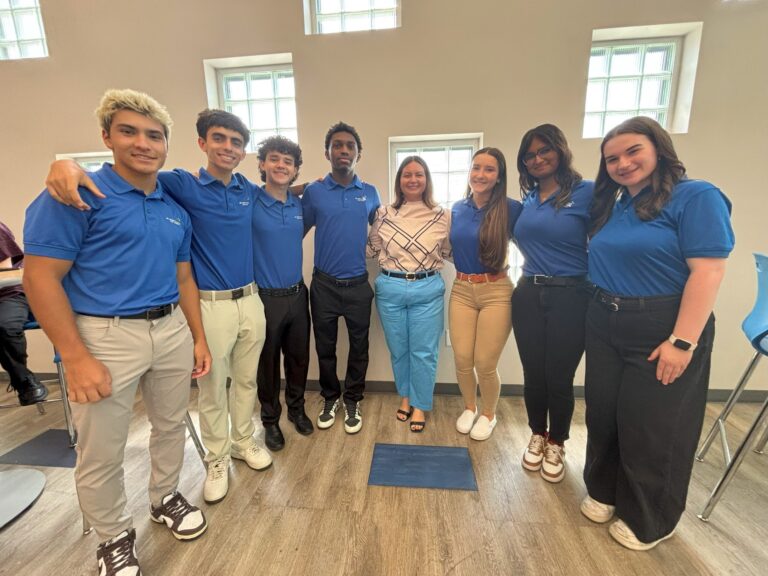
A big thank you to Principal Lauren Carnell and the Dr. Kiran C. Patel High School team for so warmly hosting Florida Charter Institute’s 2025 Governance Conference. The conference brought together charter school leaders from all over Florida to spend the day learning and connecting. Thank you to the Patel High School student leaders who showcased their future-ready skills through their interactions, public speaking, and technology assistance- our attendees were impressed with their abilities, the campus, and the extraordinary programs available to help students succeed.
Are you a charter school interested in hosting next year’s conference? Reach out to our conference leader, Christine Mentis, at cmentis@flcharterinstitute.org for more information.
Additional Information From Our Team
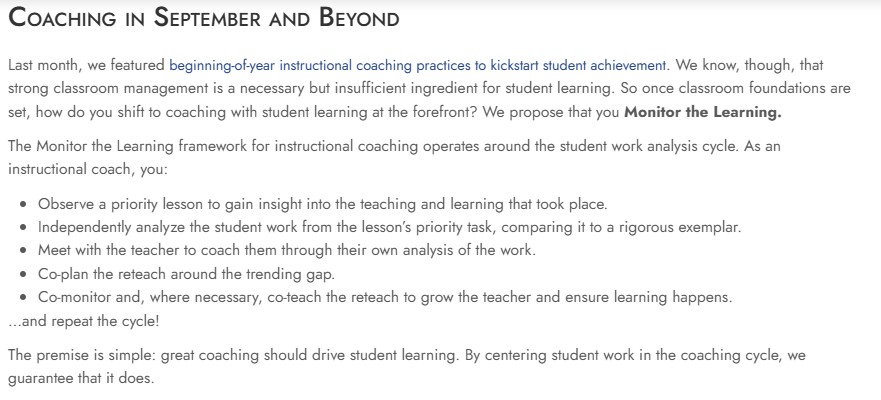
Straight from our FCI Insights blog, learn about the Monitor the Learning framework for instructional coaching and how it operates around the student work analysis cycle. Read more here.
Join Our Mailing List!
Sign up to receive email notifications from the FCI regarding upcoming trainings, webinars and receive notification when a new issue of FCI Connect is available!
By submitting this form, you are consenting to receive marketing emails from: Florida Charter Institute. You can revoke your consent to receive emails at any time by using the SafeUnsubscribe® link, found at the bottom of every email. Emails are serviced by Constant Contact
FCI Connect is the monthly newsletter from the Florida Charter Institute. FCI’s mission is to serve as Florida’s premier hub for charter excellence and insight by providing research-based best practices, resources, and support. FCI is powered by Miami Dade College and authorized in Florida statute.
Do you have issues or topics you would like to see addressed in future issues of FCI Connect? Send your comments, suggestions or questions to us at info@flcharterinstitute.org.