
November 2025 FCI Connect | How Students Learn

Welcome to the October edition of FCI Connect

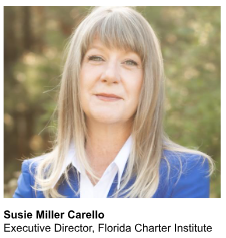
From the desk of our Executive Director

Teaching for Thinking: Helping Students Learn Deeply in Every Classroom

If you’ve ever tried to help a seventh grader untangle fractions at 7:45 a.m., you know this truth in your bones: math is not a spectator sport. It’s also not a magic trick, a personality trait, or a talent reserved for the chosen few. Math is thinking work. And as it turns out, Barak Rosenshine—and a few decades of cognitive science—have a lot to say about how to make that thinking work.

This month, the Florida Charter Institute (FCI) is zooming in on Rosenshine’s Principles of Instruction in an age when AI can spit out a step-by-step solution faster than a middle schooler can locate their pencil. The question isn’t, “Will AI change math instruction?” It already has. The real question is: Will we let technology make students lazier thinkers—or stronger ones?

Rosenshine gives us a roadmap. Daily review that keeps essential knowledge from evaporating. Small, well-scaffolded steps instead of cognitive cliff dives. Lots of checks for understanding, guided practice, and—my personal favorite—a high success rate so students experience what it feels like to actually get math. Cognitive science tells us that learning sticks when we reduce unnecessary load, build durable schemas, and give students plenty of low-stakes rehearsal before the big performance. This month, FCI’s Director of Exceptional Student Education, Reagan Chalmers, reminds us that the Rosenshine roadmap is true a decade later; that we, in fact, have known for a very long time how to make instruction powerful; and we should DO IT!

Now layer AI on top of that. Imagine using AI to generate more worked examples, varied practice sets, or quick retrieval quizzes—not to bypass thinking, but to create more opportunities for it. Imagine a world where teachers spend less time formatting problem sets and more time watching students’ eyes, listening to their reasoning, and adjusting instruction in real time. That’s the sweet spot: Rosenshine’s principles as the backbone, cognitive science as the engine, and AI as the very efficient assistant—not the driver.

In this issue, Paul Powell, Executive Director at True North Classical Charter Schools in Miami, and FCI’s Executive Deputy Director for Teaching & Learning Kathryn Perkins dig into how Florida charter schools can marry timeless principles of instruction to make math learning more powerful and frankly, more joyful. Because at the end of the day, it’s not about the app, the platform, the AI or the latest shiny thing. It’s about a student, a teacher, a well-crafted problem, and a brain that’s being invited—relentlessly and lovingly—to think.

Let’s get to work.


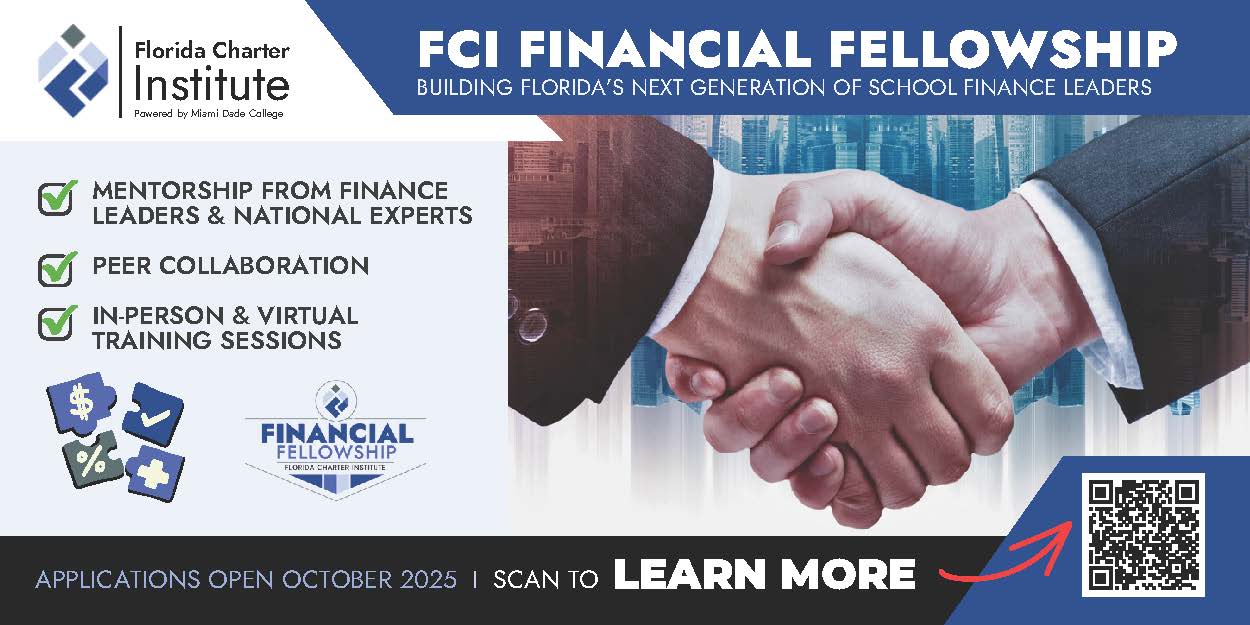
Announcing the FCI Financial Fellowship: Now Accepting Applications


The Florida Charter Institute (FCI) is launching the Financial Fellowship, a premier program starting January 2026. This initiative is designed to prepare finance professionals to step into senior leadership roles, protect taxpayer dollars, and ensure schools have the financial stability they need to focus on students.

As a Fellow, you’ll:

  • Work alongside a cohort of peers and seasoned finance mentors.
  • Discover best practices from national experts in school finance, facilities acquisition, FTE forecasting, and board relations.
  • Participate in in-person and virtual sessions focused on real-world challenges in charter schools.
  • Develop the skills and confidence to step into senior fiscal leadership roles.

.

The Florida Charter Institute is now accepting applications for its first cohort of financial fellows. For more information, please visit our dedicated website: https://flcharterinstitute.org/financial-fellowship/

Featured Article | Teaching That Sticks: Bringing Rosenshine’s “Principles of Instruction” Into the AI Era (and Why It’s Especially Powerful for Students with Disabilities)

Reagan Chalmers, Director of Exceptional Student Education, FCI 

Every so often, you come across an article that never loses its power to inspire. For me, that piece is Barak Rosenshine’s “Principles of Instruction.” Even though it was written over a decade ago, it still feels like the clearest roadmap for effective teaching — simple, research-based, and timeless. Rosenshine studied what the most effective teachers already do. He found that great teaching isn’t flashy — it’s structured, intentional, and anchored in how the brain learns best: review, small steps, questioning, modeling, and feedback. These practices help all students, but for those with disabilities, they are transformative. Clear structure, repetition, and explicit instruction are not just supports — they are access points. And now, with the help of AI tools, teachers can bring these principles to life more easily than ever, saving time on preparation while focusing on connection and feedback. Here’s a highlight of Rosenshine’s “Principles of Instruction” coupled with AI technology to make this a functional addition to any teacher’s classroom. 

Start with Review
Rosenshine begins with a simple idea: start every lesson by revisiting prior learning. He wrote, “Daily review can strengthen previous learning and lead to fluent recall.” For students with disabilities, this daily review reinforces memory and reduces anxiety. AI can help teachers quickly generate personalized warm-ups from yesterday’s lesson or create differentiated versions for diverse learners. When every student begins the day with something they can succeed at, confidence grows — and so does retention. 


Teach in Small Steps 

“Our working memory,” Rosenshine explained, “is small. It can only handle a few bits of information at once.” Teaching in small, manageable chunks gives students the chance to process deeply and practice accurately. For students with disabilities, smaller steps mean fewer chances to feel lost. Teachers can use AI to break complex tasks into mini-lessons or create simple visuals and checklists to support recall and focus. Clarity, not speed, builds mastery. 


Ask Questions — Lots of Them 

“Questions help students practice new information and connect new material to prior learning.” Frequent questioning keeps all learners active and prevents misconceptions from taking root. AI can save time by generating scaffolded question sets — from recall to reasoning — for mixed-ability groups. The goal is engagement: every student thinking, responding, and rehearsing knowledge until it sticks.


Model and Guide 

Rosenshine reminded us that many skills are best learned through modeling and guided practice: “Providing students with models and worked examples can help them learn to solve problems faster.” For students with disabilities, modeling makes the invisible visible. Teachers can record themselves thinking aloud while solving a problem, then use AI to generate captions, summaries, or practice sets. Guided practice — the “we do” phase — is where confidence builds and errors are caught before they harden into habits. As Rosenshine warned, “Practice makes perfect, but practice can be a disaster if students are practicing errors.” 


Scaffold, Review, and Celebrate Success 

Rosenshine’s later principles — feedback, scaffolding, and regular review — align perfectly with modern special education best practices. Students with disabilities thrive when feedback is immediate, tasks are structured, and review is ongoing. AI tools can automate simple review quizzes or generate visual supports and “I can” statements, freeing teachers to focus on what matters most: the conversation, encouragement, and connection that make learning human. 


Why It Still Matters 

Rosenshine’s work bridges cognitive science and classroom practice. It’s as relevant today as it was in 2012 because it reflects what truly helps students learn — and remember. For students with disabilities, these principles are more than effective strategies; they’re an equity tool. Technology doesn’t change what great teaching looks like — it just makes it more achievable. When we blend Rosenshine’s timeless wisdom with today’s AI tools, we make high-quality instruction scalable, sustainable, and inclusive. As Rosenshine said, “The art of teaching is helping a novice develop strong, readily accessible background knowledge.” That’s still the heart of our work — and now, we have more ways than ever to help it stick.

FCI Insights | The Science of Math: What does cognitive science tell us about learning math?

By Paul Powell, and Kathryn Perkins, FCI Educate 

Earlier this month, we hosted a new workshop for our team titled “The Science of Math.” This represents an area of increasing importance, not just close to home here in Florida. Nationally, the most recent NAEP assessment, considered “our nation’s report card, showed alarming trends in math, including a continued lack of post-COVID recovery (though the downward trend began well before) and the greatest declines for students already performing in the bottom quartile. As written earlier this year: “The country’s lowest-scoring students are in free fall.”

As such, we’ve been thinking a lot about math lately, pondering the questions: What does cognitive science tell us about learning math? And how can we make these takeaways applicable and actionable at the school and classroom level? 

In an earlier blog on the topic, we focused on the power of retrieval practice; this month, we’ll shift to introducing new material effectively. 

Explore or Explicit?

Researchers have often posed the question of whether to introduce new material via student exploration or direct instruction, and the research is confusing, with multiple studies in each camp citing positive effects of the approach. 
The Research

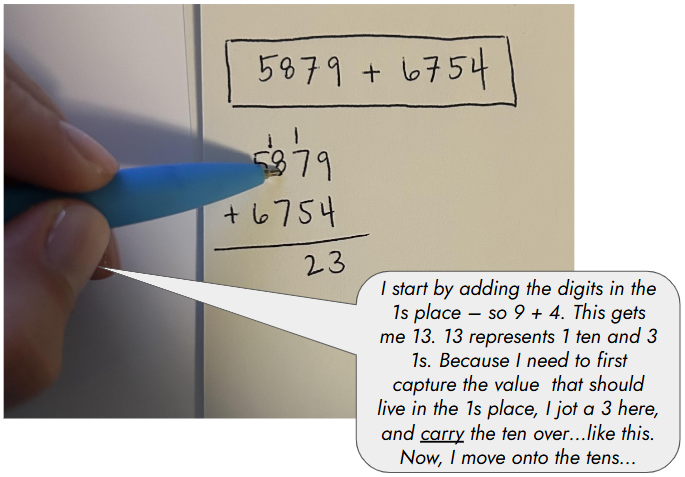
While both approaches can add value pending context, at FCI, we put a stake in the ground that worked examples, an example of direct instruction, are often part of the best introductions to new material. A worked example refers to a step-by-step illustration of problem solving, completed live with students. Once complete, it offers a lasting record of the thinking needed for success with similar problems in the future (see image at right).

The benefits of direct instruction are well-documented, with one of the strongest research bases of all teaching practices. Moreover, it has been shown to be most important for students struggling with content, which means it represents one of the possible solutions to our nation’s current “bottom falling out” trend. Within the world of direct instruction, worked examples show real impact. In the only meta-study on the subject, conducted by esteemed researcher John Hattie, worked examples were demonstrated to have an effect size of 0.48 – crossing the 0.4 “hingepoint” for high-impact teaching practices. 

Leveraging the Worked Example

We’re excited to share a clip of a powerful worked example in action – by taking you where we haven’t yet ventured in this blog: into the world of calculus! (And before you stop reading, give this a shot! We promise you don’t have to be a calc expert – or even calc comfortable – to glean best practice from the clip.) 

A little context: Jose Cobo, a high school calculus teacher at True North Classical Academy, is about to roll out a new topic, convergent geometric series, with his students. High level, if you add an infinite set of consecutive numbers, as described by a series, and the sum approaches a number (rather than infinity), we say that the series converges. (See below for the notes that Mr. Cobo shared with students for more on the mathematical concepts and notation, if of interest.)
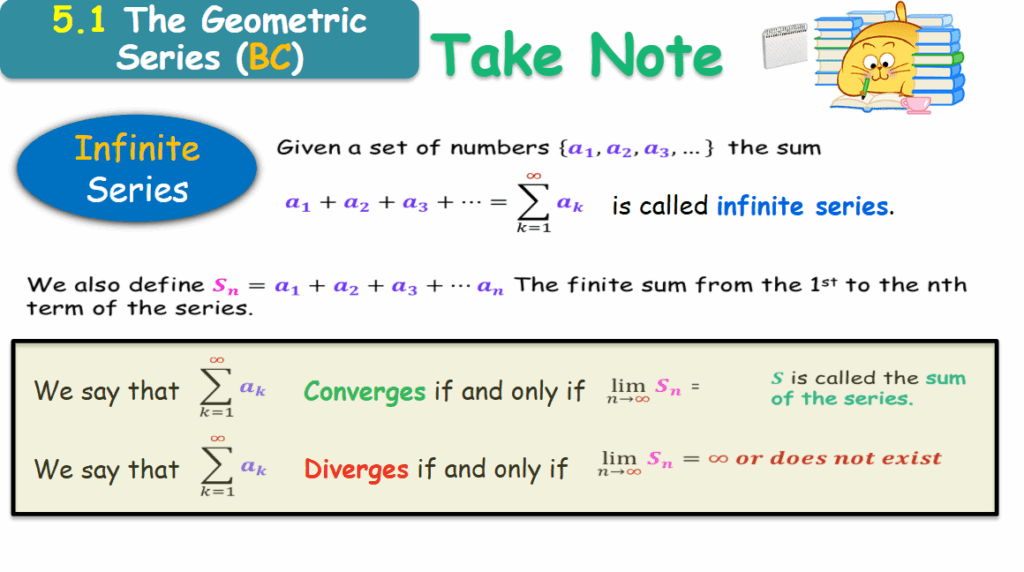
As you watch this clip, consider how Mr. Cobo leads the worked example to introduce this concept. What is its general structure? When does Mr. Cobo choose to engage the students in the example by asking questions, and when does he decide to think aloud the content himself? Let’s take a look.

You may have noticed how Mr. Cobo thinks aloud when introducing new process and concepts to his students:

  • Process: naming “what” and “how” (e.g., “Let’s get some of the values. When k=1…” or “Look at this trend. S1 is __, S2 is __…”)
  • Concepts: naming the “why” behind a particular move (e.g., each number in a series represents the sum of all the previous numbers: “S2 represents the sum of the first two values in the sequence, so we can plug in ½ + ⅙ here.”)

You likely also noticed that Mr. Cobo kept students engaged in the activity via quick questions when they were already fluent in the content. Examples included both basic fact fluency (“What is ¾ + 1/20?”) as well as vocabulary (“What do we call this?” [partial sum]).

Complex content but simple teaching. And transferable to any math – or any content, for that matter. We hope you’ll try it out the next time you’re introducing new material. Let us know how it goes!

Professional Development Programs

December 4 – 5, 2025 | Miami, FL
Our partners, Teach Like a Champion, are headed back to Florida this December 4-5 for a workshop on Engaging Academics in Miami.
 
Teach Like a Champion is the preeminent facilitator around instructional best practice, having studied positive outlier teachers for nearly 20 years — we couldn’t recommend them more and know participants will get so much out of this workshop, which will cover research-backed practices like Cold Call, No Opt Out, Right is Right, Stretch It, Everybody Writes, Wait Time, and Check for Understanding.
 
Register here https://teachlikeachampion.org/engagingacademicsdec2025
 

FCI On The Move: Our Team in the Community

Join Our Mailing List!

Sign up to receive email notifications from the FCI regarding upcoming trainings, webinars and receive notification when a new issue of FCI Connect is available!​


By submitting this form, you are consenting to receive marketing emails from: Florida Charter Institute, 11011 SW 104th St., Miami, FL, 33176, https://flcharterinstitute.org. You can revoke your consent to receive emails at any time by using the SafeUnsubscribe® link, found at the bottom of every email. Emails are serviced by Constant Contact

FCI Connect is the monthly newsletter from the Florida Charter Institute.  FCI’s mission is to serve as Florida’s premier hub for charter excellence and insight by providing research-based best practices, resources, and support. FCI is powered by Miami Dade College and authorized in Florida statute.  

Do you have issues or topics you would like to see addressed in future issues of FCI Connect? Send your comments, suggestions or questions to us at info@flcharterinstitute.org.