

On November 3rd, FCI is hosting a full-day professional development session on the science of math at the MDC West campus in Miami. Today’s piece outlines one of the topics. We hope you will join us.
In 2022, just 44% of 8th graders were able to answer this math question from the National Assessment of Educational Progress (in 2019, 50% got it correct).
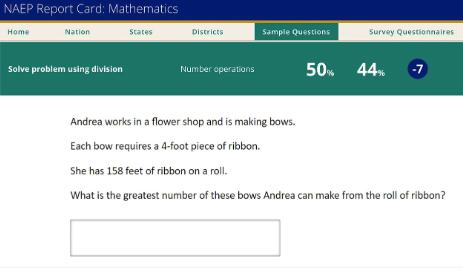
This problem requires a knowledge of division. Specifically, one needs to determine which part of a quotient is applicable given the context of the problem. Or someone with strong number sense could probably yield a correct answer.
Student thinking might sound like, “four times four is 16 so 40 pieces of ribbon would require 160 feet so that means 39 pieces of ribbon would be 156 feet. Thus, Andrea can make 39 bows.”
The 56% of 8th graders who were unable to arrive at a correct answer are going to struggle in any math class at the Algebra level and beyond. To have a majority of 8th graders unable to think mathematically at a basic level is a crisis.
If we had a baseball team where 56% of the team couldn’t hit, the improvement plan would involve teaching hitting skills and lots of practice. A soccer team where 56% of players struggle to possess the ball would get drills to dribble, pass, and receive with control. In no situation would we have our struggling athletes discover how to hit better by going into a batting cage and saying try to hit the fast pitch without specific coaching or guidance. A coach wouldn’t ask, “How do you want to hold the bat?” and let players pick their grip.
So we arrive at our focus for this piece, how to resolve the crisis in math understanding through improving practice. Increasing the quality and volume of effective practice is a simple solution to increase math mastery
Q: How does one build number sense in students so that all 8th graders can answer problems like the one above?
A: Through high-quality practice. What cognitive scientists call cognitively aligned retrieval practice.
Well-designed practice facilitated with intent can make a big difference (see links to studies below). Combining the research evidence with the study of high performing math teachers yields a recipe for effective practice. Here are some of the key ingredients we’ve found in every high growth and high performing math classroom.
- Clear parameters
- Desirable Difficulty
- Environment Focuses Attention
- Pencil to paper supports this
- Separate practice for fluency/automaticity and mastery
- Track Progress
- Give quick and frequent feedback
Clear parameters
As humans, we are much more likely to be successful when we understand the goal of the activity, what success looks like, the time we have, and have a stretch goal. This might sound like:
“You have five minutes to complete problems 11-17. As you work, remember: your line-by-line solving, equals signs lined up, organize your scratch work, and if you finish early – try the challenge problem #30. I’ll be around – remember, if I give you a check that means correct and if I circle or underline something that means check your work. Sophia – can you restate what we’re working on? [Sophia shares] – that’s right. Pencils up, begin. [The teacher starts the timer, checks to ensure all students get started and begins monitoring and checking work.]
So many times, practice falls short because we miss focusing student attention with clear parameters, leaving learners who are less proficient to practice less effectively. Our teaching time is fixed, so maximizing each minute of practice is a way to recapture our scarcest resource.
Desirable Difficulty
The cognitive science research turns the idea of productive struggle on its head. The bevy of evidence points to a much higher optimal success rate for students, somewhere between 80-85%. Aiming for this target then requires teachers to really prepare the practice problem set and cover variations of a concept in the instruction. If a teacher doesn’t solve the problem set and know which tasks are different, then students, often those that struggle, misapply what they’ve learned because they don’t recognize the difference.
Focus Environment, Focus Attention
Research by cognitive psychologists suggests that the best way to focus our attention is to create an environment where distractions are limited. There is a cognitive load added when music is playing, when wall space is cluttered, or when screens are present. Thus, the best practice spaces provide only the necessary materials for math practice. Everything else should be out of line of sight. This also means that students should have time to make meaning of problems and questions themselves before sharing with a partner, table group, or class. Otherwise, there will be those who do not engage with the content since they can rely on their peers to take on the work.
Pencil to Paper Work
The best way to engage with mathematics is through pencil-to-paper work. Screens are distracting and an inefficient way to represent math work. While sometimes helpful for visualization, teachers can easily demonstrate such visuals on the projector and then have students practice representing them in their notes. If a student cannot represent a cube on paper or draw an x-, y-, z-coordinate system, they have not truly mastered it. We need to create the space and instruction to teach such skills, whereas screens often do the work for the students.
Separate practice for fluency/automaticity and mastery
Meta-analyses have confirmed the strong correlation between early-grade fact fluency and later math mastery. However, many math curricula do not come with resources to teach fluency daily through high-repetition practice. Such problem sets exist for purchase, but be wary of computer-based programs. Checking a box on a Chromebook is not the same as reproducing work on paper, and many schools have seen the limitations of a computer-based fluency program. The best programs are pencil-to-paper and have students engage in daily practice on a topic for several days or a week. Progress is measured and then posted so students can see their growth.
Consider the free, research-proven program, Facts on F.I.R.E. created by Dr. Brian Poncy. This is a great resource for K-5th grade teachers who want to build fluency with five minutes of daily practice.
As mastery grows above 80%, many high performing teachers ask students to do mental math. They present a fact or quick problem, give all students time to think of the answer, and then call on one, quickly giving feedback.
As students approach Algebra, simple operations are no longer enough. Fluency must be built in pre-Algebra skills as well as fractions, decimals, and percents. If not, students will hit cognitive overload before solving the problem.
Quick Feedback and Track Progress
Practicing the wrong way to do something is dangerous. Each time a student engages with a cognitive task, neural pathways are strengthened, encoding the knowledge or skill into long-term memory. Errors can also be encoded. This means that we want students to get frequent feedback about what they are doing right and what is wrong so they can immediately fix the error and resolve misunderstandings.
To do this, teachers circulate with an answer key that shows the correct answer and the work to get there. A detailed key allows teachers to focus not just on what is right or wrong, but also on the misconceptions underlying the errors. The result is the opportunity to address misunderstandings before the class ends.
In Conclusion
We can unlock the next level of mastery with our students if we increase the effectiveness of practice. It has been effective for teachers, math leads, and coaches to do an inventory of how their students are practicing and pick two or three of the ingredients above to implement and adapt. If we’ve piqued your interest, we encourage you to send a few team members to our session on November 3rd. We will cover retrieval practice and much more.
—-
Research on Power of Retrieval Practice
Hopkins, R. F., Lyle, K. B., Hieb, J. L., & Ralston, P. A. S. Spaced retrieval practice increases college students’ short- and long-term retention of mathematics knowledge. Educational Psychology Review, 28, 853–873.
Ophuis-Cox, F. H. A., Catrysse, L., & Camp, G. The effect of retrieval practice on fluently retrieving multiplication facts in an authentic elementary school setting. Applied Cognitive Psychology, 37, 1463–1469.
Lyle, K. B., Bego, C. R., Ralston, P. A. S., & Immekus, J. C. (2022). Spaced retrieval practice imposes desirable difficulty in calculus learning. Educational Psychology Review, 34, 1799–1812.