
October 2025 FCI Connect | Creating Learning Teams
Welcome to the October edition of FCI Connect
Creating Learning Teams
Florida’s charter schools are strongest when every team learns together. This month’s FCI Connect explores how learning drives excellence at every level—from the boardroom to the classroom.
From the Desk of Susie Miller Carello, we highlight the essential role of charter-school finance leaders and announce the Florida Charter Institute Financial Fellowship, a new initiative designed to strengthen financial leadership across the charter sector.
Our Research Division examines how rethinking the use of underutilized public-school facilities can expand opportunities for charter students, while our FCI Educate division shares how collaborative professional learning empowers teachers and improves outcomes.
Together, these stories show how Florida’s charter schools continue to lead as true learning organizations—innovating, adapting, and growing stronger for students statewide.
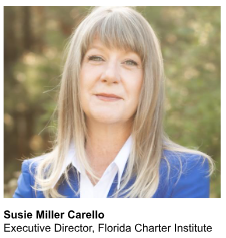
From the desk of our Executive Director
The Unsung Heroes of Charter School Success: Finance Leaders
Charter schools run on vision, but they survive on numbers. Every board of trustees needs to know if the mission is sustainable—and that’s where the unsung heroes of charter school finance come in. Business managers, directors of finance, and CFOs may never get a standing ovation at graduation, but they are the ones making sure there is actually a graduation to attend. Without sharp financial leadership, a charter school’s great academic story can end with a bad audit.
These finance leaders need to think and act like members of the C-suite, because in reality, that’s exactly what they are. The CEO might set the vision, but it’s the finance chief who provides the dashboard—the real-time metrics that keep the board steering straight. Enrollment numbers aren’t just headcounts; they are revenue forecasts. Days of cash on hand aren’t just an accounting detail; they are the oxygen supply of the school. Variances in the budget are not nuisances; they are early warning sirens.
Too often, though, charter school boards only see finance as “the treasurer’s report” wedged between committee updates and the principal’s showcase of student projects. That’s a mistake. Finance is not a side dish—it’s the main course. A school that doesn’t know its financial pulse can’t make smart decisions about growth, staffing, or facilities. The finance director’s job is to deliver data not as a swamp of spreadsheets, but as a crisp story: here’s where we are, here’s what it means, here’s where we’re headed.
At the end of the day, charter schools live and die on their ability to balance idealism with realism. A board can have the boldest vision for students, but without a finance leader who sees the whole chessboard, the vision collapses under the weight of unpaid bills. If you want your charter school to thrive, empower your finance team to operate as the strategic leaders they are. Because in this sector, the math isn’t just math—it’s mission.
Warm Regards,
Susie
Announcing the FCI Financial Fellowship: Now Accepting Applications
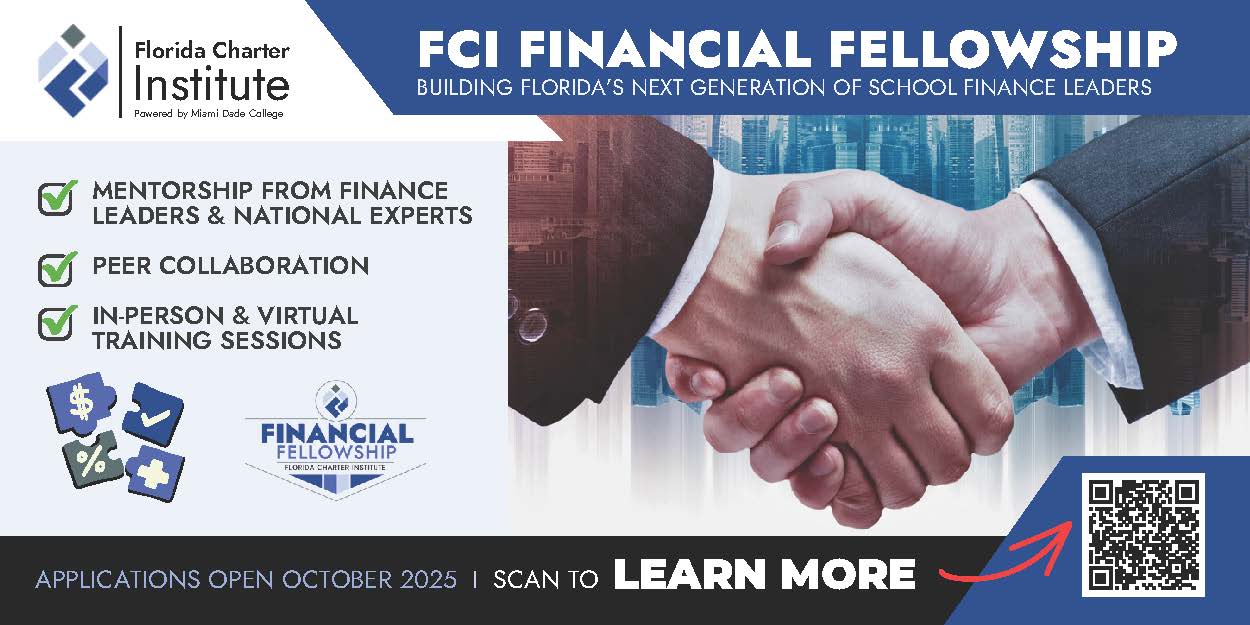
The Florida Charter Institute (FCI) is launching the Financial Fellowship, a premier program debuting in October 2025. This initiative is designed to prepare finance professionals to step into senior leadership roles, protect taxpayer dollars, and ensure schools have the financial stability they need to focus on students.
As a Fellow, you’ll:
- Work alongside a cohort of peers and seasoned finance mentors.
- Discover best practices from national experts in school finance, facilities acquisition, FTE forecasting, and board relations.
- Participate in in-person and virtual sessions focused on real-world challenges in charter schools.
- Develop the skills and confidence to step into senior fiscal leadership roles.
.
The Florida Charter Institute is now accepting applications for its first cohort of financial fellows. For more information, please visit our dedicated website: https://flcharterinstitute.org/financial-fellowship/
Featured Article | New Study Shows There’s a Better Way to Utilize Emptying School District Buildings
Thibaut Delloue, FCI Policy Fellow
A new study by the Florida Charter Institute reveals that Florida’s school district buildings, facing falling student enrollment, are sitting empty—leaving space for the state’s growing charter school sector to fill the void.
The report, titled Space to Succeed: Possibilities & Potential For Florida’s Underutilized School Buildings, analyzes 20 Florida counties that contain 90 percent of the state’s charter schools. It shows that enrollment in traditional district schools has steadily declined in the last decade, resulting in over 645,000 seats available in district facilities—and hundreds of underused buildings that must still be maintained by taxpayer dollars. Charter school enrollment, meanwhile, has grown by over 136,000 students during that same period. It is estimated that an average of 264 school district buildings, or 12 percent of all district facilities, could house the average-sized Florida charter school.
According to the study, newly opened charter schools in Florida spend nearly one-quarter of their yearly budget on acquiring and preparing facilities for students. While the state doles out separate, facilities-related funding to charter schools, most charters pay significantly more toward rent and maintenance. By relocating charter schools inside district buildings, it’s money that could be better spent teaching our students and paying our teachers.
Declining student enrollment, meanwhile, is a growing financial concern for Florida’s school districts. Yet, despite frequent reports of district plans to close schools, the report shows that the number of school buildings being operated by districts has slightly increased across the state. In other words, shrinking funding is not being met with less district facilities, but more.
“Ultimately, repurposing half-empty—or worse—district buildings for in-demand charter schools is about leveraging public resources and potential cost savings for districts and charter schools,” the report argues. In fact, only four percent of Florida charter schools operate in district-owned buildings, compared to 18 percent across the country. .
It’s not just Florida—falling school enrollment is a nationwide problem. As FCI’s report points out, research suggests that “traditional school districts nationwide retain more public resources than is proportional to their enrollment, particularly when compared to other schooling options like charter schools.”
While some commentators point the finger for declining enrollment at the usual school choice scapegoat, the causes are complex and also include demographic shifts, birth rates, and cost of living. Furthermore, these pundits confuse the various elements that make up Florida’s new education environment. Charter schools are legally public schools and unambiguously accountable to their sponsor—whether a school district, college, or university—and the state. In Florida, they’ve been around for nearly three decades and now make up around 14 percent of all public school enrollment. In truth, charter schools have grown steadily because they have been academically successful, as evidenced by both state report cards and federal data, and parents choose high-quality schools for their kids. Furthermore, school choice in all its forms remains popular in the Sunshine State, according to recent surveys by EdChoice and the James Madison Institute.
Allowing public charter schools to utilize underused district facilities is smart policy. It aims to solve a clear problem for school districts by sharing resources with other public schools. As Chad Alderman recently pointed out, the combination of increasing options for families and closing low-performing schools can benefit all students in urban districts. Such “portfolio models,” in fact, have already improved educational outcomes in Florida when compared with efforts to further fund shrinking school districts.
Ignoring emptying school buildings is not a sustainable model for Florida’s public education system. It’s time to put those resources to work by leveraging Florida’s strong charter sector, setting an example as a national solution.
FCI Insights | Creating Learning Teams and Prioritizing Growth
Kathryn Perkins, FCI Educate and Author of FCI Insights
The theme of our newsletter this month is creating learning teams – and it is my favorite yet! At the beginning of my teaching career, I was overwhelmed by all I needed to learn to be great for my students. However, because I was fortunate enough to work at a school and network that truly valued, prioritized, and invested in my growth, I was motivated and inspired by the challenge. It’s what hooked me into teaching and what kept me there, and I believe all teachers deserve the same experience.
FCI Educate exists to create opportunities for professional learning that will improve student learning, be accessible, and help teachers feel valued and invested in. We have some fantastic offerings coming up that will do all of that. For more, read on below – we hope you will join us and can’t wait to see you there!
November 3 Science of Reading and Science of Math
The transition out of “beginning-of-year” mode offers the perfect moment for educators to deep dive into content and instructional practice, ensuring a year of transformational learning. Join FCI as we host Teach Like a Champion for a workshop on the science of reading, while also hosting our very own, inaugural session on the science of math. Each promises to offer teachers and school leaders turnkey practices based on the learnings of cognitive science and clinically-proven practices from top schools and teachers.

Science of Reading with Teach Like a Champion
This full-day workshop led by world-renowned Teach Like a Champion will share the latest research from cognitive scientists on the science of reading and learning. Topics include:
- the critical role of background knowledge and fluency
- building attention
- creating strong communities of readers through shared reading
- the power of effective writing instruction in reading classes
For each area, participants will distill research-based techniques into classroom-ready strategies. Curriculum examples and video demonstrations will illustrate how these principles can be integrated into instructional materials and literacy lessons.
This workshop focuses on the language comprehension strand of Scarborough’s Rope and is best suited for educators supporting grades two and above. Content can be integrated with any school’s current curriculum.
For more information and to register, click here

The Science of Math with the Florida Charter Institute
This workshop with the Florida Charter Institute will share the latest research from cognitive scientists on the science of math and learning. Topics include:
- the critical role of math fluency
- the power of explicit instruction and worked examples
- building mathematical thinking
- structuring and facilitating quality practice
For each area, participants will distill research-based techniques into classroom-ready strategies. Curriculum samples and video demonstrations will illustrate how these principles can be integrated into instructional materials and math lessons.
Professional Development Programs
Upcoming Webinars
Thursday, October 23, 2025, 10:00 a.m. | E-Rate Program Overview
E-Rate is a federal program that helps schools cover costs for internet access, network equipment, and maintenance. Although a valuable resource, many schools find the E-Rate program complex and time-consuming. This webinar will provide a clear overview of E-Rate, covering eligibility, application steps (even for new schools), and insights into budgeting for Category 1 and Category 2 services. We’ll also walk through school requirements and setup in the E-Rate EPC portal. If you have questions or find the process intimidating, join us to hear expert guidance from Ben Sniecinski, President of E-Rate Advantage.
Register Here
Thursday, October 30, 2025, 10:00 a.m. | Designing for Access: Best Practices to Support Diverse Learners
Creating meaningful access to learning begins with intentional design. This webinar introduces practical approaches educators can use to better support students with diverse learning needs, including students with disabilities. Participants will explore high-leverage practices that promote clarity, engagement, and access to rigorous instruction. The session will also highlight key classroom “look fors” that instructional leaders can use to recognize and support effective implementation. Designed for teachers, coaches, and school leaders, this session focuses on what works in real classrooms and offers immediately applicable strategies to strengthen instructional support for all learners.
Register Here
Tuesday, November 4, 2025, 1:00 p.m. | Stay Conversations That Matter: Boosting Teacher Retention in Charter Schools
Explore how stay interviews can be a powerful tool to improve teacher retention in charter schools. This presentation offers practical strategies, sample questions, and implementation tips to help school leaders build trust, gather valuable feedback, and create supportive environments that encourage educators to stay and grow.
Register Here
Thursday, November 6, 2025, 1:00 p.m. | Applying to MDC to Open A Charter School
Miami Dade College (MDC) is excited to announce the launch of its inaugural charter school authorization process. As one of Florida’s premier higher education institutions, MDC has been approved by the state to sponsor public charter schools—providing new opportunities for high-quality educational innovation and choice for Miami’s K-12 students.
MDC, in partnership with the Florida Charter Institute (FCI), recently released its Request for Proposals (RFP) for new charter applications, with a submission deadline of Monday, December 1, 2025.
Register Here
For a full schedule of our free webinars, please visit https://flcharterinstitute.org/webinars/
FCI On The Move: Our Team in the Community
Join Our Mailing List!
Sign up to receive email notifications from the FCI regarding upcoming trainings, webinars and receive notification when a new issue of FCI Connect is available!
By submitting this form, you are consenting to receive marketing emails from: Florida Charter Institute, 11011 SW 104th St., Miami, FL, 33176, https://flcharterinstitute.org. You can revoke your consent to receive emails at any time by using the SafeUnsubscribe® link, found at the bottom of every email. Emails are serviced by Constant Contact
FCI Connect is the monthly newsletter from the Florida Charter Institute. FCI’s mission is to serve as Florida’s premier hub for charter excellence and insight by providing research-based best practices, resources, and support. FCI is powered by Miami Dade College and authorized in Florida statute.
Do you have issues or topics you would like to see addressed in future issues of FCI Connect? Send your comments, suggestions or questions to us at info@flcharterinstitute.org.