
December 2025 FCI Connect | A Year of Impact
Welcome to FCI Connect
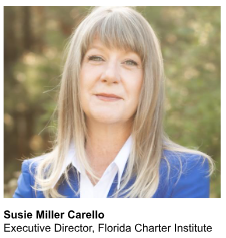
From the desk of our Executive Director
As I reflect on the year behind us, I am proud of the thoughtful work our team has done to strengthen Florida’s charter sector. In 2025, the Florida Charter Institute remained committed to helping schools deliver strong outcomes for students by supporting educators, school leaders, governing boards, and families with clear guidance, practical tools, and research-based insight. Across research, professional learning, and direct school support, our work was guided by a simple principle — quality matters, and it must be built intentionally.
Looking ahead, we will continue to raise the bar for excellence, accountability, and access across Florida’s charter landscape. I am confident in the direction of our work and grateful for our partners and colleagues who share this commitment. Together, we are building a strong future for Florida’s students.
Happy holidays and happy new year,
Susie
Featured Article | A Year of Impact, How Florida Charter Institute Showed Up for Schools, Educators, the Community and Families
This year, the Florida Charter Institute focused on helping Florida’s charter schools do their best work. We leveled up instructional excellence, strengthened governance, expanded family resources, supported new charter growth, delivered useful research, and answered the everyday questions that keep schools moving.
Here’s how we made a difference in 2025.
We Helped Teachers Level Up by…
- Hosting 27 days of in-person professional learning, impacting 710 educators and over 70 schools
- Crafting 12 blog posts covering research-backed, clinically-proven teaching and leading, each with resources to turnkey
- Delivering dozens of FCI Support Webinars and growing our resource library to support new and existing charter schools
- Authored Exceptional Student Education (ESE) tools and documents to help schools enhance their ESE programs and ensure compliance
We Supported School Leaders by…
- Organizing and executing our largest Governance Conference to date; We brought charter school board members and leaders together for focused learning on effective oversight, accountability, and mission-aligned decision-making.
- Providing hands-on technical assistance to new, growing, and existing charter schools across Florida — from compliance questions to instructional priorities to facilities and financial planning.
- Hosting 7 sessions of our Distinguished Fellowship, designed to raise the bar for school leadership through instruction in teaching and leading best practice, as well as implementation
- Creating the 2025–26 Salary Increase Allocation Calculator to support charter schools in planning, calculating, and implementing required teacher and instructional staff salary increases.
We Turned Research Into Real-World Tools by…
- Releasing the research white paper Space to Succeed: Possibilities & Potential for Florida’s Underutilized School Buildings
- Publishing 10 articles and commentary pieces in local newspapers and national education outlets such as Education Next
We Expanded Access for Families by…
- Launching the FCI Families Hub, simplifying school search tools, enrollment tips, and family-friendly resources
- Strengthening digital content, including Beyond the Headlines, research summaries, and transparency dashboards
- Providing a Florida education and charter school news feed, giving families timely updates on policies, school options, and statewide education trends
We Helped Grow Florida’s Charter Landscape by…
- Presenting 11 high-impact sessions at the Florida Charter School Conference — spanning leadership, finance, governance, instructional excellence, and research
- Supporting the launch of Miami Dade College’s new authorizing work in 2025 and into 2026
- Expanded FCI’s digital footprint through revamped newsletters, thought-leadership pieces, and user-friendly online resources, ensuring schools and families received timely, actionable information.
We Invested in the Future by…
- Developing the first Florida charter school Financial Fellowship Program for 2026
- Growing our team to better serve our charter community– we have welcomed our Executive Finance Director, Director of Exceptional Student Education, FCI Support Lead, Project Manager, and Administrative Assistant
As we conclude 2025, we are appreciative of the educators, school leaders, governing boards, and partners whose dedication made this year’s progress possible. Their commitment strengthened Florida’s charter sector and advanced our shared goal of delivering high-quality educational opportunities statewide. We look forward to continuing this work in 2026 and building on the momentum established this year.
FCI Insights | Another Notch in the Belt for Retrieval
By Paul Powell, and Kathryn Perkins, FCI Educate
A few months back, we wrote about the value of regular, systematic retrieval practice in the math classroom. The headline: retrieval is essential for learning. Without repeated, spaced at bats with interleaved information that lead to the sweet spot of “desirable difficulty,” there is no transfer from working to long-term memory, and therefore, no learning.
While the power of retrieval to encode new information is already well known, a new study piqued our interest this week as it offered a new – and powerful – benefit of retrieval practice. In “Effects of retrieval practice on retention and application of complex educational concepts,” Daniel Corral and Shana Carpenter studied how retrieval impacts not just memorization, but the ability to apply learned information to new situations (“transfer”). They found that retrieval benefits both.
Carl Hendrick summed it up beautifully:
The key finding was that three rounds of retrieval practice produced significantly better performance than restudy and quiz study on both repeated questions (testing the same material) and application questions (requiring learners to apply concepts to novel scenarios) when tested one week later. Importantly, this transfer advantage persisted even when controlling for memory accuracy, suggesting retrieval enhances learners’ ability to recognise when a concept is relevant in a new context, not just their memory for the concept itself.
Given its heightened importance, we thought we’d spend this month refreshing our most recent blog on retrieval, which includes a great clip of retrieval in action.
Designing Retrieval Practice
If the content (rather than delivery) is more your focus, we also wanted to offer some new examples of high-impact retrieval practice. Below, we’ll offer two samples – one from 3rd-grade math and one from Algebra 1 (they’re also here if you’d like to return to them later). Try out one or both, completing it as a student would while reflecting as an educator:
- What stands out to you about the structure of the practice or the process of completing it?
- How do the practice sets achieve desirable difficulty?
What did you notice? Maybe you pulled out the repeated practice and skill interleaving (in 3rd grade: multiplication and division – plus the skill of determining how to handle an unknown in different places). As the student, we also hope you felt the practices hit desirable difficulty, offering the gentle pressure of cognitive load throughout: while similar, the problems weren’t similar enough to put you on autopilot, which we know slows learning. (In fact, research shows that the most impactful fluency practice falls in the 70-80% mastery window.) Maybe you thought to yourself that practice like this would only take a few minutes each day – crucial, since we know how valuable classroom time is.
Pitfalls to Avoid
While regular retrieval offers undeniable value add to instruction, there are key pitfalls to avoid – namely:
- Seemingly endless problem sets: The best retrieval happens daily – but in short bursts. Think 2-5 minutes total, with its corresponding number of problems.
- Problem sets that offer little variation: If students repeat essentially the same problem over and over, they go on autopilot, and the result is practice that is too easy. Remember: interleaving skills supports hitting the desirable difficulty that leads to most efficient learning.
- Not offering feedback: Retrieval is only effective if students get immediate feedback on their work. This doesn’t have to be time intensive or lengthy: at a minimum, share answers aloud and have students correct their papers; ideally, leave time for a quick review of 1-2 challenging problems – even if this just means stating a response and a 1-sentence explanation.
- Compromising new material: If we aren’t disciplined, retrieval practice can take more time than we initially allotted, thereby compromising the introduction of new material. A quick fix here is to set a timer and stick to it. You might even engage students in a time challenge – though remember, too, that it’s important to keep retrieval low stakes.
We hope you’re inspired to try it out, and maybe even commit to a regular retrieval cycle in your classroom in 2026. Wishing you a wonderful holiday and a happy New Year until we see you back in January.
Professional Development Programming
The Florida Charter Institute is pleased to partner with the Florida Institute for Classical Learning to invite our community to an in-person professional learning experience for classical educators across Florida.
This statewide summit brings together teachers, school leaders, professors, co-op leaders, and supporters for two days of collaboration, learning, and connection—designed intentionally for in-person engagement.
Event Details
Dates: May 1–2, 2026
Location: Florida International University, Steven J. Green School of International & Public Affairs | Miami, FL
Program Overview:
Friday: Registration, opening remarks, and keynote
Saturday: Three learning tracks (Teachers, Leaders, Supporters), shared lunch, and closing session
Programming concludes by 5:00 p.m.
Register: https://flclassical.org/2026summit/
Participation is limited to ensure a high-quality experience.
Sign-up for event updates: https://flclassical.org/join-community/
We encourage educators to attend with colleagues—professional learning is strongest when it is shared. The Florida Charter Institute is proud to support this partnership and looks forward to welcoming our community to Miami.
Join Our Mailing List!
Sign up to receive email notifications from the FCI regarding upcoming trainings, webinars and receive notification when a new issue of FCI Connect is available!
By submitting this form, you are consenting to receive marketing emails from: Florida Charter Institute. You can revoke your consent to receive emails at any time by using the SafeUnsubscribe® link, found at the bottom of every email. Emails are serviced by Constant Contact
FCI Connect is the monthly newsletter from the Florida Charter Institute. FCI’s mission is to serve as Florida’s premier hub for charter excellence and insight by providing research-based best practices, resources, and support. FCI is powered by Miami Dade College and authorized in Florida statute.
Do you have issues or topics you would like to see addressed in future issues of FCI Connect? Send your comments, suggestions or questions to us at info@flcharterinstitute.org.